
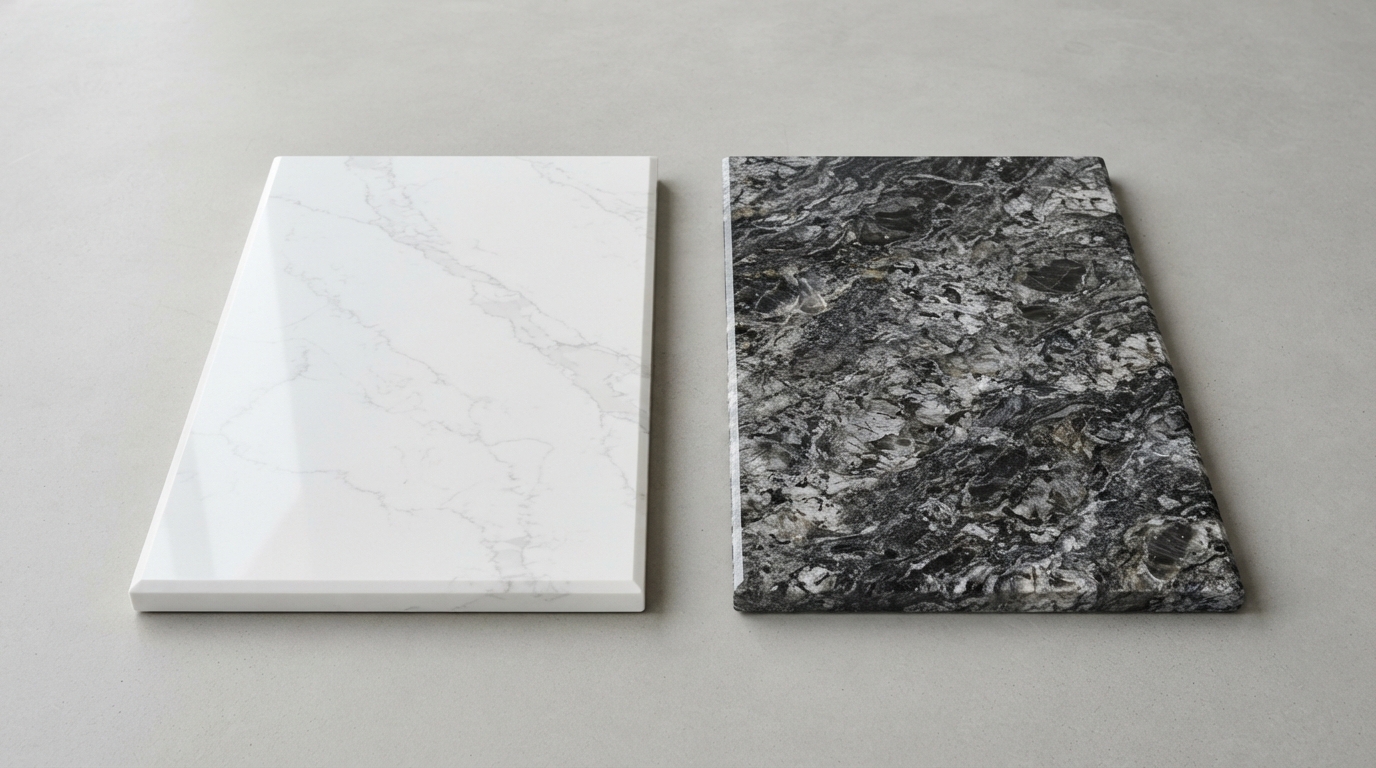
Quartz or granite?
It sounds like a simple countertop decision until you start looking at full slabs, edge profiles, maintenance requirements, warranties, fabrication, and total installed cost.
Both materials can work well in a Jacksonville kitchen. Neither is automatically the better choice.
Quartz generally appeals to homeowners who want a more consistent appearance and less routine maintenance. Granite appeals to homeowners who want genuine natural stone and the variation that comes with it.
The better choice comes down to how you cook, how much maintenance you want to manage, what kind of appearance you prefer, and which specific product or slab fits the rest of your kitchen.
And despite plenty of claims online, Florida humidity does not give us a good evidence-based reason to automatically favor quartz or granite indoors. Our research did not find primary material-science or manufacturer evidence showing that Jacksonville humidity or coastal air materially changes the normal performance comparison between the two materials.
Quartz vs. Granite: The Short Answer
Here is the practical comparison:
| Factor | Quartz | Granite |
|---|---|---|
| Material | Engineered surface | Natural stone |
| Appearance | More controlled and repeatable | Natural variation from slab to slab |
| Sealing | Product-dependent care, but engineered quartz is generally chosen as a low-maintenance surface | Sealing needs can vary by the specific stone |
| Heat | Follow the manufacturer's care instructions and use trivets | Natural stone is often selected where heat tolerance matters, but trivets are still sensible |
| Stain concerns | Designed for relatively low absorption | Depends on the stone and how it is finished/sealed |
| Slab selection | Samples are generally more representative of the final pattern | Seeing the actual slab is especially valuable |
| Cost | Wide range | Wide range |
| Florida-specific winner? | No | No |
That last row matters.
A lot of countertop content tries to turn Florida into the deciding factor. The evidence we reviewed doesn't support that.
For an indoor Jacksonville kitchen, your household habits and the actual product you're considering matter more than generic claims about humidity.
What Is Quartz?
Quartz countertops are manufactured surfaces made using mineral content combined with binders, pigments, and other ingredients.
Because the material is manufactured rather than cut directly from one natural block of stone, manufacturers can offer more controlled colors and patterns.
That makes quartz appealing if you're trying to coordinate countertops closely with custom cabinetry, flooring, backsplash tile, or a specific kitchen color palette.
It also means you should evaluate quartz by product, not just by the word "quartz."
Different brands and product lines can have different formulations, warranties, care instructions, heat precautions, certifications, and restrictions.
That becomes especially important if your kitchen has unusual conditions such as extensive direct sunlight or if you're thinking about continuing the same countertop into an outdoor space.
What Is Granite?
Granite is natural stone.
That means the color, mineral composition, pattern, movement, and veining can vary from slab to slab.
For some homeowners, that's exactly the point.
You aren't choosing a printed pattern that's designed to repeat. You're choosing a piece of stone with its own character.
That also means a small granite sample may not tell the whole story.
If natural variation matters to you, look at the actual slab that will be fabricated for your kitchen whenever possible. A four-inch sample can't show every vein, mineral deposit, color shift, or area of movement across a full countertop.
For homeowners trying to preserve character in an older Jacksonville home or create a kitchen that feels less uniform, that natural variation can be a feature rather than a drawback.
Quartz vs. Granite at a Glance
There isn't one category where either material wins every homeowner.
Think about the comparison as a series of tradeoffs.
Quartz may make more sense if you:
- prefer a more predictable pattern
- want relatively simple day-to-day upkeep
- don't want countertop sealing to be a recurring consideration
- are coordinating the surface tightly with other finishes
- are comfortable following the manufacturer's heat-care instructions
Granite may make more sense if you:
- strongly prefer natural stone
- want a slab with individual variation
- enjoy selecting the exact stone
- are comfortable asking about the maintenance requirements of that particular granite
- care less about perfect pattern consistency
Neither list tells you what you should buy.
It helps you determine which material behaves more like the countertop you actually want to live with.
Appearance: Natural Variation vs. Predictability
This is one of the easiest differences to understand.
Granite gives you natural variation.
Quartz gives you more control.
With granite, veins, mineral flecks, colors, and patterns can change across the slab. Two slabs with the same stone name may still look noticeably different.
That makes slab selection important.
If you fall in love with a particular section of a granite slab, ask how the fabricator plans to lay out the countertop pieces. Sink cutouts, seams, corners, islands, and backsplash sections can all influence where the most distinctive parts of the stone end up.
Quartz generally provides more visual predictability. That's useful if you want the countertop you saw in a sample or showroom to translate more consistently across the kitchen.
Neither approach is better design.
One celebrates variation.
The other gives you more control.
Which One Is Easier to Maintain?
Maintenance is one reason many homeowners begin comparing quartz and granite in the first place.
The original ZimmWriter draft made the comparison too simple by suggesting that all granite follows essentially the same resealing schedule and that Jacksonville humidity speeds up seal deterioration. We don't have strong primary evidence for that Florida-specific claim.
A better approach is to ask about the specific material you're buying.
Natural Stone products can differ in absorption characteristics and maintenance needs. If you're considering granite, ask the supplier or fabricator:
- Does this particular stone need a sealer?
- If so, what product is recommended?
- How do I know when it needs attention?
- Which cleaners should I avoid?
- What does the fabricator recommend for daily care?
For quartz, follow the countertop manufacturer's care documentation. Don't assume every cleaner is appropriate simply because the surface is engineered.
For either material, wiping spills promptly and using cutting boards is an easy habit.
The goal isn't to find a countertop you can abuse indefinitely.
It's to choose one whose normal care requirements fit your household.
How Quartz and Granite Differ in Everyday Care
Quartz
- Generally does not require the same sealing routine associated with many natural-stone surfaces
- Follow the specific manufacturer's cleaning and care instructions
- Protect the surface from concentrated heat using trivets or hot pads
Care requirements are product-specific. Follow the documentation for the exact quartz product you are considering.
Granite
- Maintenance depends on the specific stone and its condition
- Ask whether the selected stone needs sealing
- Follow the supplier or fabricator's recommended care instructions
- Use appropriate cleaners for the specific stone
Different stones can have different needs. Ask about the care requirements for the exact slab you are selecting.
Maintenance is product-specific. Ask for the care instructions for the exact countertop you are considering.
What About Heat?
Heat resistance gets oversimplified online too.
A better homeowner rule is:
Use a trivet or hot pad regardless of which countertop you choose.
Engineered quartz products can contain binders or resins whose behavior under concentrated heat is different from natural stone. Manufacturer care instructions should determine what is acceptable for the specific product you're considering.
Granite is natural stone and is often chosen where homeowners place a high value on heat tolerance, but that doesn't make setting extremely hot cookware directly on a finished countertop a necessary habit.
Using a trivet takes two seconds.
Repairing a damaged countertop takes considerably longer.
More importantly for Jacksonville homeowners, ambient Florida heat is not the same issue as putting hot cookware directly on the countertop. The original draft occasionally blended those two ideas. Your cooking habits are the relevant factor indoors—not the fact that you live in Florida.
Does Jacksonville Humidity Matter?
Not enough for us to recommend one material over the other based on humidity alone.
Our research specifically looked for manufacturer documentation, material-science studies, or standards demonstrating that Florida humidity or coastal salt air materially changes quartz or granite countertop performance.
It didn't find evidence strong enough to support those claims.
Most statements saying things like "Florida humidity means granite must be sealed more often" came from contractor or fabricator marketing content without supporting test data.
That's exactly the kind of localization we don't want to manufacture.
Jacksonville climate absolutely matters for some home-improvement decisions—windows, exterior materials, roofing, outdoor spaces, moisture management, and home performance are good examples.
But that doesn't mean climate needs to become the deciding factor in every product comparison.
For indoor quartz vs. granite countertops, focus primarily on the material, manufacturer or stone characteristics, maintenance, installation, appearance, and how your kitchen gets used.
What About a Kitchen With a Lot of Direct Sun?
This deserves more attention than humidity.
Engineered products can have manufacturer-specific limitations concerning UV exposure or outdoor use. Our research did not find strong enough Jacksonville-specific UV evidence to justify declaring one countertop universally better based on local UV index data.
So if you have a kitchen with:
- floor-to-ceiling windows
- skylights
- heavy afternoon sun
- large west-facing glass areas
- a countertop that continues into an outdoor kitchen
ask about the actual product warranty.
Don't settle for "quartz is fine in Florida" or "granite never fades."
Ask:
Is this specific product warranted for the exposure it will receive?
That's more useful than a generic material claim.
Two Different Questions: Hot Cookware and Direct Sun
Hot Cookware
- Concentrated heat from cookware is a different issue from normal indoor air temperature
- Engineered quartz products can contain binders or resins whose behavior under concentrated heat differs from natural stone
- Granite is often chosen where heat tolerance matters, but trivets are still sensible
- Follow the manufacturer's care instructions for the specific product you are considering
Use a trivet or hot pad regardless of countertop choice.
Direct Sunlight
- Engineered products can have manufacturer-specific limitations concerning UV exposure or outdoor use
- Do not assume all quartz fades or all granite never fades
- Consider conditions like floor-to-ceiling windows, skylights, heavy afternoon sun, or outdoor kitchen use
- Ask: Is this specific product warranted for the exposure it will receive?
If a countertop will receive strong direct sunlight, review the documentation and warranty for the specific product being considered.
How Much Do Quartz and Granite Countertops Cost?
There isn't a responsible universal answer saying quartz always costs more or granite always costs more.
Pricing overlaps.
The total installed price can depend on the specific material or slab, thickness, availability, fabrication, edge profile, number of cutouts, seams, sink configuration, backsplash work, transportation, and installation requirements.
A relatively common granite may price differently from a rare natural slab.
A basic quartz product may price differently from a premium designer pattern.
That's why we would not repeat the original draft's claim that "granite usually costs more than quartz." The evidence we reviewed doesn't support using that as a universal rule.
When you're comparing countertop proposals, ask for the installed price based on the same scope.
That should include enough detail that you can understand:
- material
- square footage
- fabrication
- edge treatment
- sink cutouts
- faucet or cooktop cutouts
- seams
- removal of existing counters if applicable
- installation
- backsplash if applicable
The countertop number also needs to make sense within the larger kitchen budget. Our Jacksonville kitchen remodel cost guide explains how countertops fit alongside cabinetry, appliances, installation, flooring, and other project costs.
What Are Homeowners Choosing Right Now?
Quartz remains widely used, but popularity shouldn't make the decision for you.
The 2026 U.S. Houzz Kitchen Trends Study reported that engineered quartz represented 32% of countertop selections among surveyed homeowners upgrading countertops, compared with 15% for granite. Quartzite accounted for 10%.
The study was national, not Jacksonville-specific.
It also measured homeowner preferences—not product performance.
So don't read those numbers as:
Quartz is twice as good as granite.
They mean:
Among this surveyed renovation audience, engineered quartz was chosen more frequently.
That's useful trend context, but you're still buying a countertop for your kitchen, not voting in a popularity contest.
One Countertop Issue Homeowners Rarely Hear About: Fabrication Safety
There is one current issue worth knowing about because it affects how countertops are fabricated and installed.
In February 2026, OSHA and NIOSH published updated guidance addressing worker exposure to respirable crystalline silica during countertop manufacturing, finishing, and installation. The alert covers both engineered stone and natural stone.
This is a worker-safety issue involving dust-producing fabrication and installation, not a warning that living with an installed quartz or granite countertop is inherently dangerous.
That's an important distinction.
As a homeowner, you don't need to become an occupational-safety expert. But it is reasonable to ask a fabricator how cutting and finishing are handled and whether appropriate dust controls and worker protections are used.
Especially if fabrication or field cutting will occur at your home.
That's a practical provider-selection question that most countertop comparison articles never mention.
What About Countertop Certifications?
If product certifications matter to you, ask about the specific material, not just quartz or granite as broad categories.
For example, NSF/ANSI 51 establishes public-health and sanitation requirements for materials used in commercial food-equipment applications. Some countertop products may carry relevant certifications, although residential countertops are not universally required to have them.
For engineered materials, some products may also carry GREENGUARD or GREENGUARD Gold certification for chemical-emission performance. Those certifications apply to specific products—not every quartz surface on the market.
The absence of a particular voluntary certification does not automatically mean a countertop is unsafe.
But if indoor-air-quality or product-certification standards matter to your household, asking about them gives you something concrete to compare.
Which Countertop Makes More Sense for Your Florida Kitchen?
Here's the simplest decision framework.
Quartz may be the better fit when:
You want a controlled look, relatively straightforward maintenance, and don't mind following manufacturer precautions around concentrated heat or other product-specific limitations.
Granite may be the better fit when:
You want genuine natural stone, enjoy variation between slabs, and are comfortable understanding the care requirements of the specific stone you select.
Neither one wins simply because you live in Jacksonville.
That may be the most useful conclusion of the entire comparison.
You don't need an invented Florida rule.
You need the countertop that fits the way your kitchen works.
Questions to Ask Before Choosing Quartz or Granite
Before ordering either material, ask:
- What is the total installed price?
- Can I see the actual granite slab or a full-size quartz display?
- What maintenance does this exact product require?
- Does this granite need sealing?
- What cleaning products does the manufacturer or supplier recommend?
- What heat precautions should I follow?
- Are there sunlight or outdoor-use limitations?
- What warranty applies?
- What is excluded from that warranty?
- Where will seams be located?
- How will sink and cooktop cutouts be handled?
- Will any cutting take place inside or around my home?
- What happens if the slab or finished countertop is damaged before installation?
Those questions will tell you more than asking a salesperson which material is "better."
Which Countertop Fits the Way You Use Your Kitchen?
What appearance do you prefer?
- Natural slab variation from stone to stone
- More controlled or repeatable appearance across the surface
Granite gives you natural variation. Quartz gives you more visual predictability. Neither is better design — one celebrates variation, the other gives you more control.
How do you feel about maintenance?
- Are you comfortable following stone-specific care and possible sealing recommendations?
- Do you prefer a surface generally selected for lower routine maintenance?
Maintenance is product-specific. Ask about the care requirements for the exact countertop you are considering rather than assuming all granite or all quartz behaves the same way.
How is the kitchen used? Consider your cooking habits, hot cookware use, cleaning habits, and overall household activity level.
What does the actual installed quote include? Review the material or slab, fabrication, edge profile, cutouts, seams, sink configuration, backsplash work where applicable, and installation requirements. What does the specific product documentation say? Review the care instructions, warranty, heat precautions, and any sunlight or exposure limitations.
Frequently Asked Questions
Choose the Countertop for the Way You Actually Live
The showroom is where countertops catch your attention.
Your kitchen is where you find out whether you made the right choice.
Think about what happens there every day.
Do people gather around the island? Do you cook frequently? Are spills common? Are you particular about visual consistency? Do you love natural materials? Will you actually follow the care instructions?
Then compare the actual quartz product and granite slab in front of you—not generic assumptions about either category.
Jacksonville Home Improvements exists to help homeowners understand those decisions before making an important project commitment. You can explore our kitchen remodeling resources or learn more about kitchen remodeling in Jacksonville.
When you're ready to move from research to planning, Start My Project explains the next step and lets you request project assistance.
You remain in control of the final hiring decision. Independent providers are responsible for their own estimates, pricing, contracts, scheduling, permits, workmanship, warranties, payment terms, and project completion.
Sources & References
- 2026 U.S. Houzz Kitchen Trends Study — homeowner countertop preference data (survey conducted July 2025)
- OSHA / NIOSH — worker exposure to respirable crystalline silica during countertop manufacturing, finishing, and installation (February 2026 guidance)
- EPA — granite countertops and indoor radon
- Natural Stone Institute — natural stone care and maintenance guidance
- NSF / ANSI 51 — material safety standards for food-equipment applications
- UL / GREENGUARD — chemical-emission certification standards