
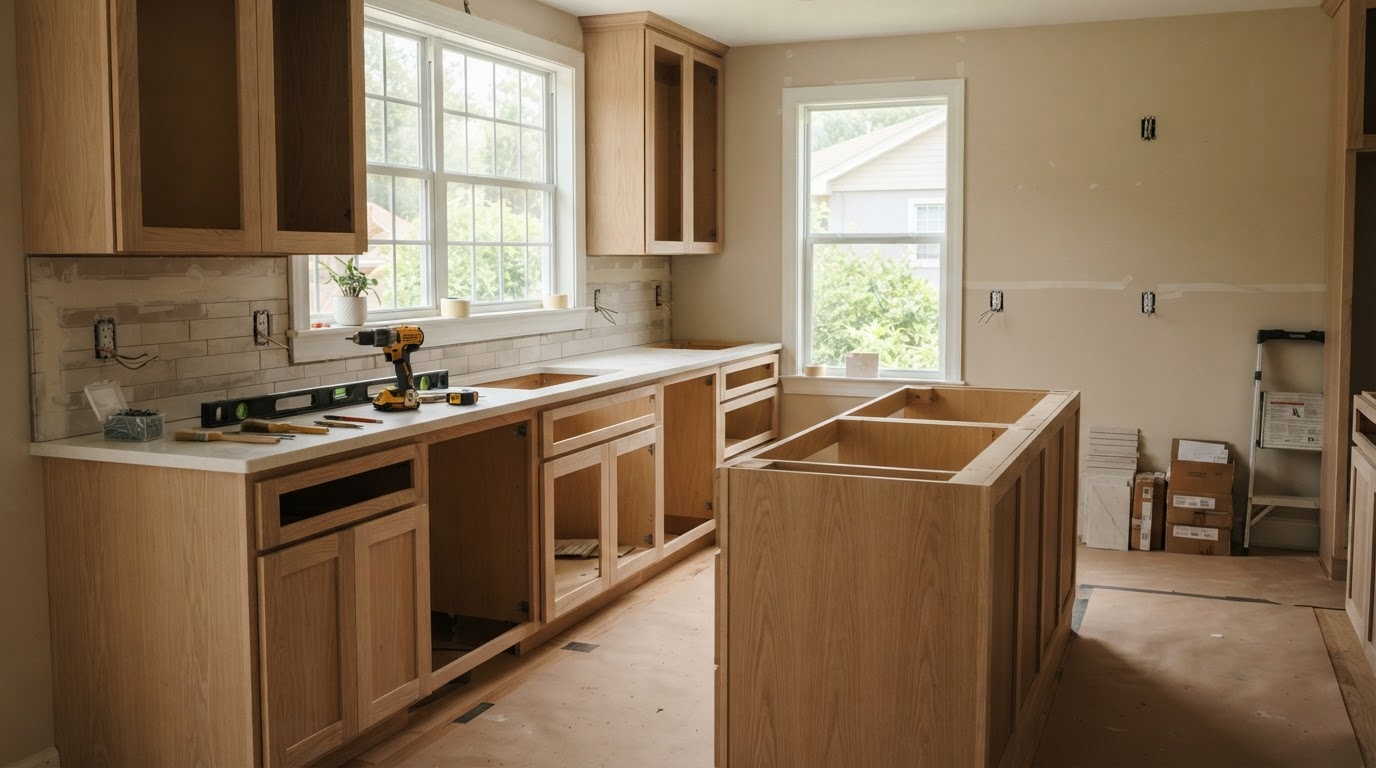
Maybe.
The permit question in Jacksonville depends on what your kitchen remodel actually includes.
Painting walls, replacing cabinets, installing new countertops, or changing flooring can fall into exempt finish-work categories. Moving plumbing, adding electrical circuits, changing structural walls, or modifying mechanical or gas systems is different. Those types of work can require permits even when they are part of the same overall kitchen project.
There is also an important new Florida rule in effect as of July 1, 2026. Florida House Bill 803 created a permitting exemption for certain work valued at less than $7,500 on single-family dwellings, but that exemption does not apply to electrical, plumbing, structural, mechanical, or gas work. It also has additional conditions, including a written exemption request and a flood-hazard-area exclusion.
So the safest answer is not "yes" or "no."
It is:
Define the scope first, then verify which parts of the project require permits before work begins.
The Short Answer: Does a Jacksonville Kitchen Remodel Need a Permit?
Some kitchen remodeling work does. Some does not.
Under the Florida Building Code, cabinets, countertops, tiling, carpeting, painting, and similar finish work are listed among permit-exempt activities when they do not involve regulated electrical, plumbing, structural, mechanical, or gas work.
On the other hand, work such as:
- adding or changing electrical wiring
- installing new circuits or outlets
- relocating plumbing
- moving a sink
- removing or altering walls
- changing structural framing
- modifying gas or mechanical systems
can trigger permit requirements.
The important distinction is that a project can contain both exempt and permitted work.
For example, replacing cabinets may be exempt, but if the cabinet project also requires relocating outlets or plumbing, those trade changes can still require permits.
Does Your Kitchen Project Involve More Than Finish Work?
Permit requirements depend on what your project actually includes. Use this framework to think through the scope before assuming anything.
Finish-Focused Work
- Painting
- Cabinets
- Countertops
- Tile
- Flooring
These types of finish work may fall within permit exemptions when they do not involve regulated electrical, plumbing, structural, mechanical, or gas work.
Regulated Systems or Structural Work
- New or relocated electrical
- Plumbing relocation
- Wall removal
- Structural changes
- Mechanical changes
- Gas work
These types of changes can trigger permit requirements.
One kitchen remodel can contain BOTH exempt work and permit-required work.
Define the scope first. Then verify the applicable permit requirements before work begins.
Kitchen Remodeling Work That May Not Require a Permit
The Florida Building Code specifically exempts several types of finish work.
For kitchen projects, the most relevant examples include:
- painting
- tiling
- carpeting
- cabinets
- countertops
- similar finish work
That means a kitchen update limited to replacing cabinets, countertops, and flooring—without electrical, plumbing, structural, mechanical, or gas changes—can generally fall within the finish-work exemption identified in the code.
Cabinet replacement
Replacing cabinets in the same general configuration without changing electrical or plumbing systems is treated as exempt finish work under FBC §105.2.
That does not mean every cabinet project is automatically permit-free.
If cabinet changes require moving outlets, altering wiring, relocating plumbing, or changing a wall, the related trade or structural work can still require permits.
Countertop replacement
Countertop replacement without electrical or plumbing changes is also listed within the finish-work exemption.
But replacing countertops and moving the sink at the same time is a different project because plumbing relocation becomes part of the scope.
Flooring
Tiling, carpeting, and similar finish flooring work are also identified as exempt finish work under the Florida Building Code.
Again, the exemption applies to the finish work itself. It does not cancel permit requirements for other regulated work being performed as part of the same remodel.
Plumbing Changes Can Trigger Permit Requirements
Plumbing relocation is one of the clearest lines between a cosmetic kitchen update and a more involved remodel.
Moving a sink, relocating supply lines, changing drain locations, or otherwise altering the plumbing system can require a permit under the Florida Building Code's general permit rule.
One narrow exception Jacksonville specifically publishes is the replacement of plumbing faucets after the stop, excluding water heaters. The City lists that as exempt work.
So these are very different projects:
Replacing a faucet in the same location
may fall under an exemption.
Moving the sink to an island
involves plumbing relocation and can require permitting.
That difference is why homeowners should discuss the exact scope, not simply ask whether "a kitchen remodel" needs a permit.
Electrical Work Needs Similar Attention
Electrical work also depends on what is changing.
The research confirms that new circuits, new outlets, rewiring, and similar electrical-system changes require permitting.
Jacksonville has a separate local rule for certain like-for-like replacements. Under Jacksonville Ordinance §320.408(f), replacement of light fixtures, switches, ceiling fans, and receptacles in a single-family residence may be performed without plan review or inspection.
But that does not mean the work is entirely permit-exempt. The ordinance still requires the permit to be obtained and paid for, with a Notice of Commencement submitted when applicable.
That distinction matters.
No plan review or inspection is not the same thing as no permit.
Homeowners should not assume replacing an existing fixture and adding a new circuit are treated the same way.
They are not.
What About Removing a Kitchen Wall?
Wall removal is another area where the answer changes quickly.
Florida Building Code §105.2.2 excludes work involving cutting away a wall or partition from the ordinary-minor-repair category. The research therefore identifies removal of an interior wall—even a non-load-bearing wall—as work that requires a permit.
Load-bearing or structural changes are even clearer. Structural work remains subject to permit requirements regardless of whether the overall project falls below the new $7,500 threshold.
So before removing a wall between a kitchen and dining room, determine:
- whether the wall is load-bearing
- whether electrical wiring runs through it
- whether plumbing or mechanical components are inside it
- what plans or documentation the City requires
- which permits apply to the actual work
Do not treat wall removal as a cosmetic decision simply because the finished kitchen will look more open.
Same Room. Very Different Project Scope.
Finish-Focused Kitchen Update
- Replace cabinets
- Replace countertops
- Paint walls
- Replace finish flooring
When these items do not involve regulated trade or structural changes, they may fall within applicable finish-work exemptions.
Expanded Kitchen Remodel
- Relocate the sink
- Add electrical circuits or outlets
- Remove a wall
- Alter structural framing
- Modify mechanical or gas systems where applicable
These changes can introduce plumbing, electrical, structural, mechanical, or gas permit requirements.
Permitting follows the work being performed — not simply the label “kitchen remodel.”
Florida's New Under-$7,500 Permit Exemption
This is one of the most important updates for Jacksonville homeowners in 2026.
Florida HB 803 became effective July 1, 2026 and created a new exemption under Florida Statutes §553.79(1)(g).
The law requires local governments that issue building permits to exempt qualifying work valued at less than $7,500 on a single-family dwelling.
But there are significant limitations.
The exemption does not apply to:
- electrical work
- plumbing work
- structural work
- mechanical work
- gas work
- property partially or entirely located in a flood hazard area as defined by the Florida Building Code
You also cannot divide a larger construction project into smaller projects simply to get under the threshold.
And to use this exemption, the owner or contractor must submit a written request for exemption along with documentation showing the nature and value of the work.
What this might mean for a kitchen project
A nonstructural, non-trade project under $7,500 may qualify.
But cabinets, countertops, and certain other finish work already have their own separate exemption under FBC §105.2, so HB 803 is not necessarily the rule you would rely on for those items.
More importantly, a $6,000 kitchen project that includes plumbing relocation does not become permit-exempt simply because it costs less than $7,500.
The plumbing work is still excluded from the new exemption.
Under $7,500 Does NOT Automatically Mean Permit-Free
Florida HB 803 created an exemption for certain qualifying work valued at less than $7,500 on a single-family dwelling, but important limitations apply.
Qualifying Conditions
- Work valued at less than $7,500
- Single-family dwelling context
- Written exemption request and documentation
- Project cannot be divided into smaller projects simply to fall below the threshold
Excluded Work
- Electrical work
- Plumbing work
- Structural work
- Mechanical work
- Gas work
The exemption does not apply to property partially or entirely located in a flood hazard area as defined by the Florida Building Code.
Jacksonville-specific submission procedures for this new exemption were not clearly published in the City materials reviewed as of August 13, 2026. Verify the current procedure with the Jacksonville Building Inspection Division before relying on the exemption.
A Jacksonville-Specific Caveat About the New Law
As of the August 13, 2026 research date, the City of Jacksonville Building Inspection Division had not published a Jacksonville-specific procedure explaining how homeowners should submit the new HB 803 exemption request.
The state law applies, but the exact local submission method—whether through a form, portal, email, or another process—was not clearly published in the City materials reviewed.
That means homeowners who think their project may qualify should contact the Jacksonville Building Inspection Division directly before relying on the exemption.
This is exactly the kind of situation where guessing can create unnecessary problems.
What Happens When Several Trades Are Involved?
A larger kitchen remodel can involve multiple regulated systems at once.
For example:
- an electrician may add circuits for appliances
- a plumber may relocate the sink
- structural work may be needed for a wall opening
- mechanical or gas work may be involved with cooking equipment or ventilation
The research confirms that electrical, plumbing, and mechanical work must be performed by appropriately licensed contractors in those trades, and those trades require separate permits associated with the project.
That does not mean every kitchen remodel needs every type of permit.
It means the permitting structure follows the work being performed.
Before signing a remodeling contract, ask:
- Which permits does this scope require?
- Who will apply for each permit?
- Who will coordinate inspections?
- Are permit costs included in the estimate?
- Is the responsibility written into the contract?
That is much more useful than discovering halfway through construction that everyone assumed somebody else was handling the paperwork.
Can a Jacksonville Homeowner Pull Their Own Permit?
Jacksonville does provide an owner-builder pathway, but it has specific eligibility and process requirements.
The City states that some properties do not qualify for the owner exception, including property that is:
- for sale
- for lease
- for rent
- occupied by people other than the owner
- held as an investment
The research also confirms that homeowners acting as owner-builders must appear in person at the Building Inspection Division.
Electrical, plumbing, and mechanical work remain subject to separate trade requirements. The City states that those types of work must be done by contractors or craftsmen certified in those trades and require separate permits.
Owner-builder rules can carry legal and practical responsibilities, so homeowners considering that route should verify the current City requirements directly rather than relying on a summary article alone.
How Are Jacksonville Permits Submitted?
Jacksonville currently requires electronic permit submission for all permit types through its online permitting system, JaxEPICS.
The research identifies the general process as including:
- creating a JaxEPICS account
- completing the application
- uploading required forms or documents
- paying permit fees
- completing plan review when required
- completing any agency review triggered by scope or location
- permit issuance after applicable requirements are satisfied
The exact documents and review steps depend on the project.
A cabinet-only update and a structural kitchen renovation should not be expected to follow the same review path.
Will My Kitchen Remodel Need Inspections?
If the permit requires inspections, the work must be inspected according to the requirements attached to that permit.
The City does not publish a single kitchen-remodel inspection schedule that applies to every project. The specific inspection stages depend on the scope of the issued permit.
Jacksonville allows inspections to be scheduled through JaxEPICS or by phone. The research also notes that a recorded Notice of Commencement must be provided before requesting inspections when one is required.
The practical lesson:
Do not cover permitted plumbing, wiring, or structural work until you know whether an inspection must happen first.
Inspection sequencing should be clarified before construction begins.
What Is a Notice of Commencement?
Jacksonville's Residential Permits guidance states that a Notice of Commencement is required when improvements exceed $5,000, with a separate $15,000 threshold identified for mechanical work.
The Notice of Commencement provides public notice related to potential construction lien claims.
The City states that it must be recorded before the first inspection is requested and a copy must be displayed at the job site.
Whether this applies to your kitchen remodel depends on the project value and permit circumstances.
This is another detail worth confirming during the preconstruction phase rather than after work starts.
What Happens If Work Starts Without a Required Permit?
Jacksonville publishes specific consequences.
The City's Residential Permits guidance states that starting permit-required work without first applying for a permit is unlawful and punishable by a $250 fine.
Jacksonville Code §320.408 also provides that, when permit-required work begins before the permit is obtained, the permit fee can become twice the regular amount, unless specific permission to proceed was granted by the Building Inspection Division.
That's a much more defensible statement than vague warnings about resale problems or insurance claims.
The better approach is simple:
Confirm before you start.
Quick Jacksonville Kitchen Permit Guide
| Kitchen work | Permit guidance |
|---|---|
| Painting | Generally exempt finish work |
| Cabinet replacement, no trade changes | Exempt finish work |
| Countertop replacement, no trade changes | Exempt finish work |
| Tile/flooring replacement | Generally exempt finish work |
| Faucet replacement after the stop | City-published exemption |
| New electrical circuit | Permit required |
| New or relocated outlets/wiring | Permit required |
| Like-for-like fixture/switch/receptacle replacement | Permit still required, but Jacksonville may waive plan review/inspection |
| Move sink or plumbing | Permit required |
| Remove non-load-bearing wall | Permit required |
| Structural/load-bearing wall changes | Permit required |
| Mixed electrical/plumbing/structural remodel | Permit required for applicable trades |
| Non-trade work under $7,500 | May qualify under HB 803 if all conditions are met |
This table summarizes the research based on the Florida Building Code, Jacksonville ordinances, and the 2026 HB 803 change. Project-specific conditions can change the answer.
Before Kitchen Work Begins
Define the Scope
What exactly is changing?
Identify the Trades
Does the project involve electrical, plumbing, structural, mechanical, or gas work?
Identify Potential Permit Requirements
Determine which portions may be exempt and which may require permits.
Establish Responsibility
Clarify who is responsible for permit applications and inspection coordination.
Verify Current Requirements
Confirm project-specific requirements with the appropriate Jacksonville authority.
Complete Required Permit/Review Steps
Complete applicable permit and review requirements before covered work proceeds.
Complete Required Inspections
Where inspections apply, coordinate them according to the issued permit requirements.
Define the Scope
What exactly is changing?
Identify the Trades
Does the project involve electrical, plumbing, structural, mechanical, or gas work?
Identify Potential Permit Requirements
Determine which portions may be exempt and which may require permits.
Establish Responsibility
Clarify who is responsible for permit applications and inspection coordination.
Verify Current Requirements
Confirm project-specific requirements with the appropriate Jacksonville authority.
Complete Required Permit/Review Steps
Complete applicable permit and review requirements before covered work proceeds.
Complete Required Inspections
Where inspections apply, coordinate them according to the issued permit requirements.
The exact process depends on the project scope. Not every kitchen remodel requires every step, permit, trade, review, or inspection shown here.
Questions to Ask Before Your Kitchen Remodel Begins
Before choosing finishes or scheduling demolition, get clear on the scope.
Ask:
- Are we keeping the sink in the same location?
- Are we adding or moving electrical outlets?
- Are we installing new circuits?
- Are any walls being removed?
- Is structural framing changing?
- Does the project involve gas or mechanical work?
- Which portions are exempt finish work?
- Which permits are required?
- Who is responsible for pulling them?
- Who schedules inspections?
- Does a Notice of Commencement apply?
- Does the property sit in a flood hazard area?
- Could the new HB 803 exemption apply?
If you're comparing proposals, our guide to comparing remodeling estimates can help you make sure permit responsibilities and exclusions are clear before you sign.
How to Verify Current Jacksonville Permit Requirements
For project-specific questions, use the City of Jacksonville Building Inspection Division as the authority.
The research identifies the Building Inspection Division at:
214 N. Hogan St., Room 280, Jacksonville, FL 32202
and lists the main phone number as:
904-255-8500
Jacksonville also uses the JaxEPICS online system for electronic permit submission and inspection-related functions.
Permit rules can change, and the HB 803 implementation process in Jacksonville was not yet fully documented on City pages at the time of this research. Verify current requirements before construction begins.
Frequently Asked Questions
Define the Scope Before You Assume Anything About Permits
A kitchen remodel is not one permit category.
It can be a collection of finish work, electrical work, plumbing work, structural work, or several of those at the same time.
That's why the smartest first step is to write down exactly what will change.
Replacing cabinets and countertops is one scope.
Moving a sink, opening a wall, adding circuits, and installing new cabinetry is another.
Jacksonville Home Improvements exists to help homeowners understand those project decisions before making a hiring choice. You can explore our kitchen remodeling resources, read our Jacksonville kitchen remodeling guide, or review our kitchen remodel cost guide.
To understand how the project-assistance process works, see how Jacksonville Home Improvements helps homeowners take a clearer next step. For details on how participating providers are evaluated, review our service provider standards.
When you're ready to move from research to planning, Start My Project lets you describe the work you're considering and request project assistance.
You remain in control of the final hiring decision. Independent providers are responsible for their own estimates, pricing, contracts, scheduling, permit responsibilities, workmanship, warranties, payment terms, and project completion.
Sources & References
- Florida Building Code 8th Edition — FBC §105.1, §105.2, §105.2.2 (permit exemptions and ordinary minor repairs)
- Florida House Bill 803 (Chapter 2026-63) — Florida Statutes §553.79(1)(g), effective July 1, 2026
- City of Jacksonville Building Inspection Division — Residential Permits guidance
- Jacksonville Code of Ordinances §320.408 — owner-builder and like-for-like replacement provisions
- City of Jacksonville JaxEPICS — electronic permit submission system