
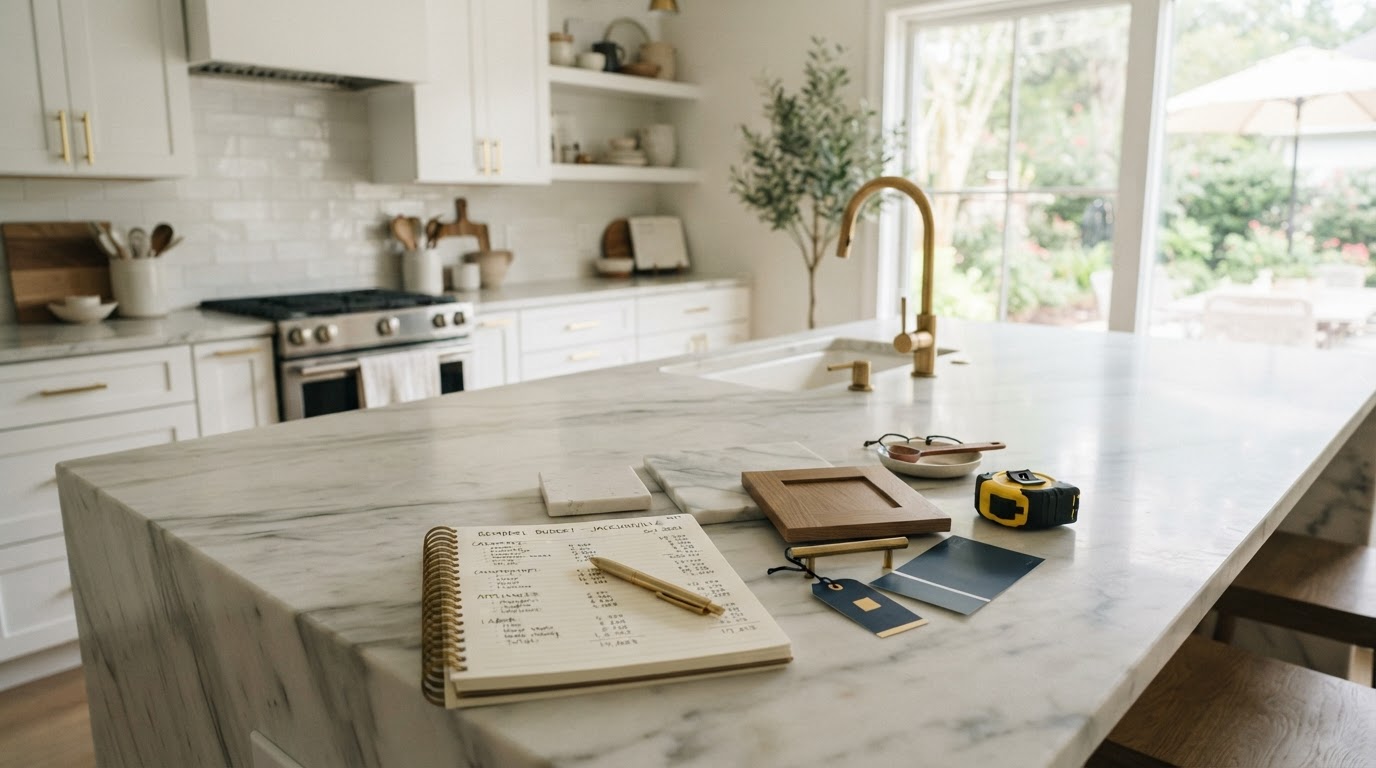
If you're planning a kitchen remodel in Jacksonville, you probably want a number before you start choosing cabinets, countertops, or appliances.
That's reasonable. The problem is that one number can be misleading.
A kitchen that keeps its existing layout and cabinet boxes is a very different project from one that replaces every cabinet, adds an island, moves plumbing, upgrades electrical systems, and installs premium appliances. Both can be called a "kitchen remodel," but their budgets aren't remotely the same.
Fortunately, we have something better than a generic national estimate. The 2025 JLC/Zonda Cost vs. Value Report includes Jacksonville-specific kitchen remodeling benchmarks. Those figures give homeowners a useful starting point—as long as you understand what each benchmark actually includes.
Jacksonville Kitchen Remodel Cost at a Glance
Standardized 2025 Jacksonville benchmarks for a 200 sq. ft. kitchen from the JLC/Zonda Cost vs. Value report:
Planning Reference Note: Published cost benchmarks are standardized planning references based on specific 200 sq. ft. scopes. An actual kitchen remodel estimate depends on your exact layout, finish selections, trade work, and provider pricing.
The Short Answer: Jacksonville Kitchen Remodel Cost Benchmarks
According to the 2025 JLC/Zonda Cost vs. Value Report, the standardized Jacksonville benchmarks were:
| Kitchen remodel benchmark | 2025 job cost | Estimated resale value | Cost recouped |
|---|---|---|---|
| Minor Kitchen Remodel — Midrange | $29,002 | $30,113 | 103.8% |
| Major Kitchen Remodel — Midrange | $82,596 | $40,667 | 49.2% |
| Major Kitchen Remodel — Upscale | $163,350 | $58,340 | 35.7% |
These are benchmark projects, not quotes, guaranteed prices, or an average of every kitchen remodel completed in Jacksonville. JLC/Zonda uses defined project specifications so similar projects can be compared from one market to another. Each kitchen benchmark assumes a 200-square-foot kitchen.
Your actual project could cost considerably less or more depending on what you're changing.
That's why the scope behind the number matters more than the number by itself.
What Do Those Jacksonville Cost Benchmarks Actually Include?
The word "minor" can be deceptive.
A homeowner might hear "minor kitchen remodel" and think about painting cabinets and changing the hardware. That's not what the JLC/Zonda benchmark describes.
Its standardized minor midrange project starts with a functional but dated 200-square-foot kitchen. The existing cabinet boxes remain, but the cabinet fronts and hardware are replaced. The project also includes new appliances, a sink and faucet, laminate countertops, trim work, wall covering, and replacement flooring.
That defined project carried a Jacksonville benchmark of $29,002 in the 2025 report.
A much smaller update—say new hardware, paint, and a backsplash—shouldn't be compared directly with that figure.
What the major midrange benchmark includes
JLC/Zonda's major midrange project goes much further. The standardized scope includes 30 linear feet of semi-custom cabinetry, a 3-by-5-foot island, laminate countertops, sink and faucet, multiple appliances, ventilation, custom lighting, new flooring, and finish work throughout the room.
Its 2025 Jacksonville benchmark was $82,596.
Notice something important: a "major" remodel does not automatically mean moving every wall or completely changing the kitchen footprint. Extensive replacement of cabinets, appliances, finishes, lighting, and other components can qualify as a major project even when the basic layout remains functional.
What the major upscale benchmark includes
The upscale benchmark moves into custom cabinetry, stone countertops, a tile backsplash, upgraded plumbing fixtures, water filtration, built-in and commercial-grade appliances, undercabinet lighting, and upgraded flooring.
The Jacksonville benchmark for that project was $163,350.
Again, that doesn't mean an upscale Jacksonville kitchen "costs $163,350." It means a very specifically defined upscale project produced that benchmark in the report.
That's an important difference when you're setting your own budget.
Why Kitchen Remodeling Costs Vary So Much
The biggest budget question isn't simply, "How big is my kitchen?"
It's:
What are we actually changing?
Keeping the existing layout tends to involve fewer moving pieces than relocating the sink, adding new circuits, opening walls, or changing structural elements.
Cabinetry is another major variable. Keeping structurally sound cabinet boxes and replacing doors is a different investment from ordering an entirely new custom cabinet package.
The same applies to countertops. Laminate, granite, engineered quartz, quartzite, and other materials can have very different material and fabrication costs. If you're still deciding between surfaces, our quartz vs. granite countertop guide walks through the practical tradeoffs.
Appliances can move the budget significantly as well. Freestanding appliances and fully integrated built-ins don't carry the same equipment or installation requirements.
Then there is everything you can't see from the showroom: demolition, electrical changes, plumbing changes, preparation, disposal, permits where required, and conditions discovered once existing finishes are removed.
Key Drivers of Kitchen Remodel Cost
The point isn't to expect a problem behind every wall.
It's to avoid budgeting as though surprises are impossible.
Where Does the Kitchen Remodeling Budget Go?
One reason kitchen budgets climb quickly is that you're not purchasing one thing. You're combining cabinetry, labor, appliances, countertops, flooring, lighting, plumbing fixtures, design, finish work, and sometimes changes to windows or doors.
National Kitchen & Bath Association planning guidance illustrates how those categories can be distributed across a kitchen budget:
| Budget category | NKBA planning allocation |
|---|---|
| Cabinetry & hardware | 29% |
| Installation | 17% |
| Appliances & ventilation | 14% |
| Countertops | 10% |
| Flooring | 7% |
| Lighting | 5% |
| Walls & ceilings | 5% |
| Design fees | 4% |
| Doors & windows | 4% |
| Faucets & plumbing | 4% |
| Other | 1% |
These percentages are planning guidelines, not a formula for your kitchen. A project that reuses cabinetry but invests heavily in appliances will look different. So will a project built around custom cabinets.
What the table does show is why cabinetry deserves attention early. NKBA's model assigns cabinetry and hardware the largest single share of the budget, followed by installation and appliances.
That means choosing cabinets before you've established a realistic overall budget can paint you into a corner quickly.
What Are Homeowners Actually Spending on Kitchen Remodels?
There's another useful source of cost information: homeowner-reported spending.
The 2026 U.S. Houzz Kitchen Trends Study surveyed 1,780 homeowners in July 2025. Houzz reported a national median spend of $55,000 for major kitchen remodels and $20,000 for minor remodels. For major projects, the median was $75,000 in kitchens of 250 square feet or more and $46,000 in kitchens under 250 square feet.
Why are those numbers different from the Jacksonville JLC/Zonda benchmarks?
Because they're measuring different things.
JLC/Zonda prices standardized project specifications in a specific market.
Houzz reports what surveyed homeowners say they actually spent across many different project configurations nationwide.
Neither number is inherently more "correct." They answer different questions.
For a Jacksonville homeowner, the JLC/Zonda numbers provide valuable local benchmark context, while the Houzz data shows how dramatically homeowner spending can vary based on project size and scope.
That's also why an online cost calculator should never replace a project-specific estimate.
How Kitchen Size and Scope Affect Cost
A larger kitchen usually needs more of almost everything: more cabinetry, countertop material, flooring, lighting, and labor.
Houzz's national survey data illustrates the effect. Median spending on major remodels was $75,000 for kitchens of 250 square feet or more, compared with $46,000 for smaller kitchens.
But size is only part of the story.
A relatively small kitchen can still become an expensive project if you're installing custom cabinetry, moving plumbing, upgrading electrical systems, changing walls, or selecting premium finishes.
Meanwhile, a larger kitchen can sometimes be approached more conservatively if the existing layout, cabinetry, or major systems stay in place.
Think in terms of scope first, square footage second.
How Much Should You Set Aside for Unexpected Costs?
A kitchen budget should have some breathing room.
The research package cites NKBA planning guidance recommending a 10% to 20% contingency for unexpected costs, with greater allowances when a project involves more uncertainty, such as extensive demolition, layout changes, or work in an older home.
That doesn't mean you should automatically spend the contingency.
It's there because remodeling happens inside an existing building. Some conditions aren't visible until cabinetry, flooring, walls, or fixtures are removed.
If nothing unexpected appears, that's a good problem to have.
If something does, you don't want the only options to be compromising the project or scrambling to find more money halfway through construction.
Does a Jacksonville Kitchen Remodel Add Resale Value?
It can, but the relationship between remodeling cost and resale value isn't one-to-one.
The 2025 JLC/Zonda Jacksonville data estimated that its minor midrange kitchen benchmark recouped 103.8% of project cost at resale. The major midrange benchmark recouped 49.2%, while the major upscale benchmark recouped 35.7%.
Those percentages should not be read as guaranteed investment returns.
They are modeled cost-versus-value estimates based on standardized projects.
What they do illustrate is something worth remembering:
Spending more on a kitchen does not automatically produce an equal increase in resale value.
A $160,000 kitchen may be exactly what one homeowner wants because they're creating a home they plan to enjoy for many years. Another homeowner may be preparing to sell and care much more about avoiding over-improvement.
Those are different goals.
Your remodeling budget should reflect why you're doing the project—not just what someone else spent.
How to Compare Kitchen Remodeling Estimates
Once you begin requesting estimates, don't line up the bottom-line numbers and automatically assume the lowest one is the best value.
First determine whether you're comparing the same project.
One proposal may include demolition, debris removal, electrical work, plumbing changes, permits where required, appliance installation, and finish work. Another might leave several of those items outside the base price.
Allowances deserve special attention too.
If a proposal includes an allowance for countertops, cabinets, fixtures, or flooring, find out what level of material that allowance will realistically purchase. A low allowance can make an estimate look attractive until selections begin.
Exclusions matter just as much.
Ask what is not included. Ask how changes are documented. Ask who is responsible for permits when they're required. Ask what happens if concealed conditions change the scope.
Our guide to comparing remodeling estimates goes deeper into that process.
Planning Benchmark vs. Project Estimate
Standardized market research data (e.g. 2025 JLC/Zonda report) evaluating fixed 200 sq. ft. specifications to track local cost trends over time.
An independent provider's detailed proposal based on your home's exact dimensions, material selections, structural requirements, and scope.
Note: Jacksonville Home Improvements provides educational benchmarks and referral assistance. Independent contractor partners evaluate your specific space and provide binding written estimates, pricing, and contracts.
The goal isn't to find the cheapest number.
It's to understand what you're actually agreeing to buy.
Frequently Asked Questions About Kitchen Remodel Costs in Jacksonville
Build the Budget Around the Kitchen You Actually Need
The most useful cost number isn't the one you find in a national average.
It's the number attached to a clearly defined scope for your kitchen.
Start by deciding what needs to change. Separate must-haves from nice-to-haves. Determine whether the existing layout still works. Decide where you're willing to invest more and where you're comfortable keeping things simple.
Then compare project options and estimates with the same scope in mind.
Jacksonville Home Improvements is designed to help homeowners understand those decisions before making a hiring choice. Explore our kitchen remodeling planning guide for more resources. If you'd like help taking the next step, Start My Project can help you share what you're planning and request project assistance.
You'll remain in control of the final hiring decision. Any independent provider you choose is responsible for its own estimate, pricing, contract, scheduling, permits, workmanship, warranties, payment terms, and project completion.
Sources & References
- 2025 JLC/Zonda Cost vs. Value Report — Jacksonville market kitchen remodeling benchmarks
- National Kitchen & Bath Association (NKBA) — kitchen remodeling budget planning allocation guidance
- 2026 U.S. Houzz Kitchen Trends Study — homeowner-reported kitchen remodeling spend (survey conducted July 2025)